Pages

Showing posts with label houses. Show all posts

Tuesday, August 2, 2011

Gothic Garden: The Witch's House


My last post was about the Witch's House in Beverly Hills, but today the focus on the property's south-facing front garden. Much of this garden receives full sun, with very few areas receiving partial shade. (The photo above was taken around 6:30pm, so those are late-afternoon shadows you see.)

First of all, I would call the landscaping at the Witch's House more of a gothic "Halloween Garden" rather than a "Witch's Garden", because it does not rely heavily on the medicinal plants and herbs that are traditionally used in a witch's garden. Instead, we see a lot of fall colors, especially blacks and oranges. (Note: black plants are almost never truly black, but the term used for very dark-colored plants.)

Here, dark-leafed, orange-flowered "Dahlia Mystic Desire" mingled with green-leaved varieties of dahlias:


 A dark backdrop was achieved with this ground cover of "Dragon's Blood" sedum (Sedum spurium), shown here near the pond's edge:


Here is a planting of pygmy crimson barberry (barberis):


A variety of dark-leaved coral bells (heuchera) were used along the sidewalk, along with orange-blossoming California poppy (Eschscholzia californica, not in bloom at this time):


Even the pads of these water lilies (Nymphaea) were streaked with a very dark purple:


We also saw much attention paid to plant form and texture.  Spine-covered Euphorbia "Lomi" Thai Giant Hybrid discourages trespassers as much as the "No trespassing" sign held in the craggy branches of manzanita (Arctostaphylos).


I'm told these tall plants resembling cornstalks are called Black Sorghum and were planted by seed:

Here is a closer look at a seedhead:
Image Detail

This type of sorghum can be used in dried flower arrangements, and has healthful antioxidant properties if eaten. The sorghums are supported by uniquely loopy wire cages as seen below:


I've no clue as to the name of this distinctive plant with its alien-looking seedheads:


Curly corkscrew rush (Juncus grass curly wurly) grows like a witch's untamed hair by the pond:

I'm not sure about this weeping shrub or young tree, but I'm guessing it's some type of Weeping Katsura (Cercidiphyllum japonicum).  The branches look like they also have a crazy twisted form:

It certainly stands out against the gothic setting of the black plants:


As I mentioned earlier, the flowers tended to be in Fall colors of orange and yellow. These are milkweed/butterfly weed (Asclepias curassavica or Asclepias tuberosa) :


Blanket flowers (Gaillardia) provided more orange and yellow blooms:


Another dahlia from the Mystic series, coreopsis, and gaillardia:


Black mondo grass (Ophiopogon planiscapus 'Nigrescens') line the pathway in the west side garden:
The dark plantings and grassy plants with an intentionally overgrown look blend the parkway strip into the overall scheme:


The hardscaping tied the home's Storybook archetechture to the surroundings by the use of various-sized stone in walls and and in walkways:
 

Landscape lighting was provided by rock-shaped fixtures. This one was postioned by the only rosebush I saw in the garden, a rose with dark red blooms:

Trellises are custom made twists of wire and resemble thorny vines:

The wooden fences had uneven pickets:

The pond is used as a moat; one must cross the bridge to get to the front door of the Witch's house:

The bridge used faux tree trunks, formed from concrete, as pillars:


This etched rock by the front gate, (partially covered by sweet peas Lathyrus odoratus that are past their prime), credits landscape designer Jane Marshall. She can be reached at her website, janemarshalllandscape.com.

Hope you enjoyed this garden tour. If I've misidentified a plant, please leave a comment to let me know.

Monday, July 25, 2011

The Witch's House


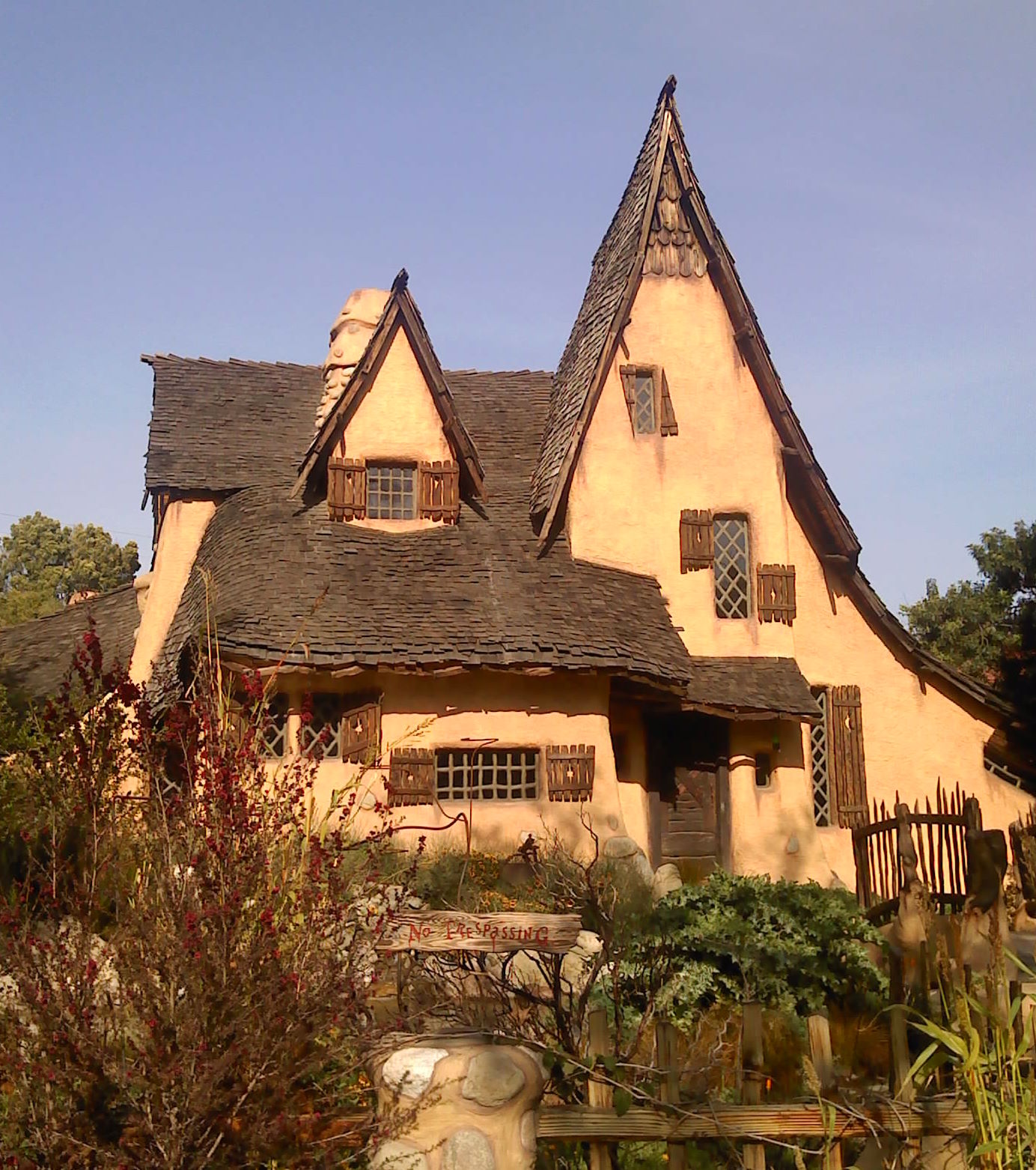
File:Spadena Witch House.jpg
The Witch's House. Photo by Kafziel


Last night I visited the magical Witch's House in Beverly Hills, arguably the foremost icon of Storybook architecture in the United States.
 Also known as the Spadena House, it is located in a quiet residential neighborhood at 516 Walden Dr., Beverly Hills, at the corner of Walden and Carmelita, walking distance from The Beverly Hilton hotel and several nice parks. 
The quirky house is not normally open to the public, but last night the owner held a political fund-raising event on the property so I was afforded the rare treat of going beyond the front yard fence.  Even better,  a 5-year renovation to the house and property had just recently been completed so everything looked pristine. Well, as pristine as a house intentionally designed to look a little dilapadated can look! 


Built in 1921 by silent film art director Harry Oliver, the structure was originally built to house offices and dressing rooms for Willat Studios in Culver City, a city to the west. When financial losses due to the advent of "talkies" struck the silent film studio, the building was abandoned and became a source of curiosity for many passing by. The Spadena family bought it in 1934 and moved it to its present, more private, location in Beverly Hills. There has only been one other owner, a woman who lived there a long time, decorated the interior in 1960's fashion, and who eventually could not keep the house and grounds from falling into disrepair. But this woman had the spirit of the house within her, and she would greet trick-or-treaters on Halloween dressed as a witch. Some began calling the place "The Witch's House" and the name stuck.


The house now belongs to 47-year old real estate agent Michael Libow, who originally merely showed the house to potential buyers back in 1998. But time after time the interested parties indicated a complete tear-down would be in order to meet their needs. No one was inclined to preserve the house. So a determined Libow bought the house himself for 1.3 million dollars, and began planning renovations to provide more living space that would blend with the existing Storybook styling he was intent on preserving.


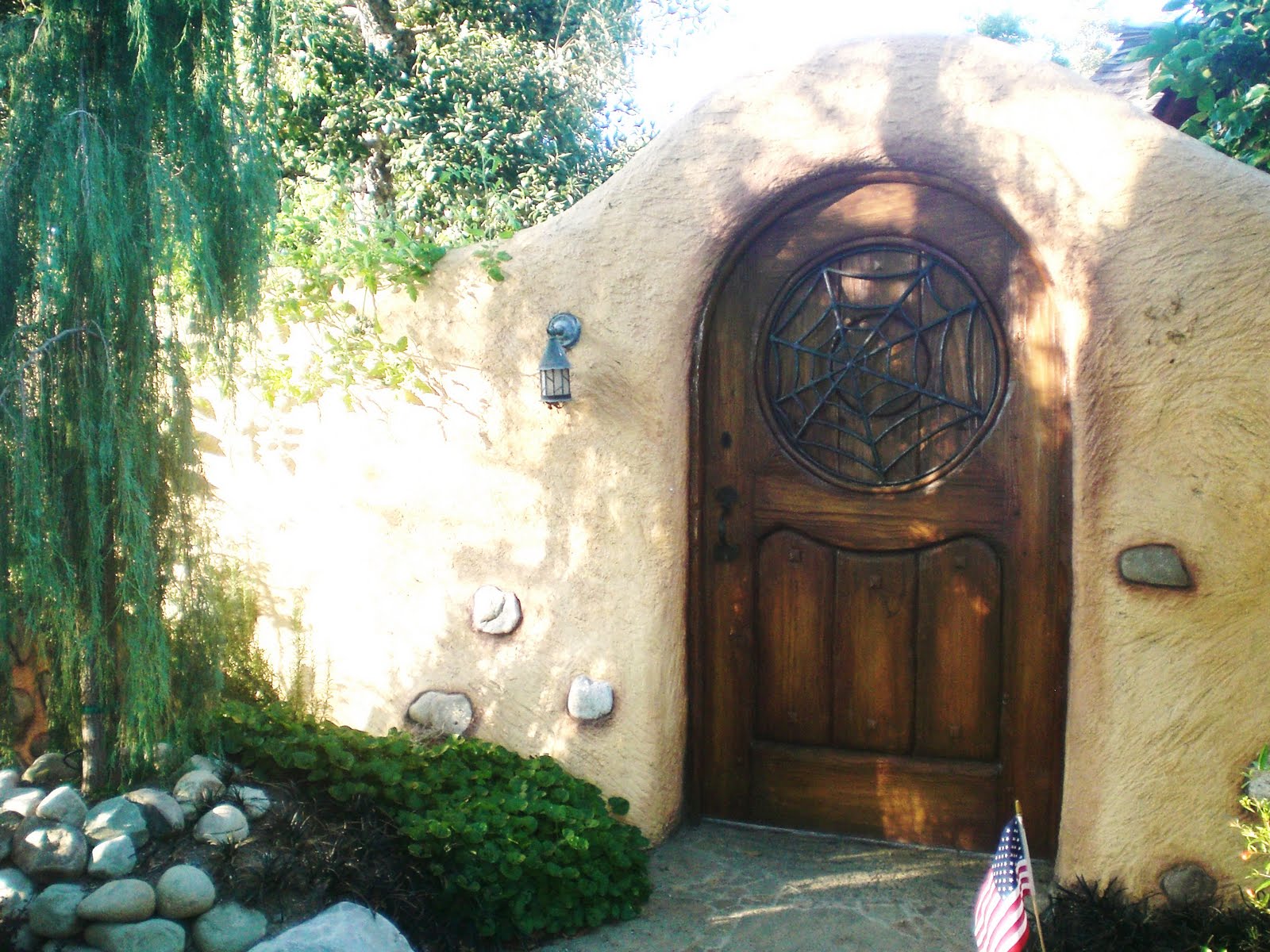
The curved wall to the sideyard contains a door with a spider web design. Note the Storybook element of the stones that are embedded in the wall.

Close-up of the wooden door and iron spider web


Quaint lighting fixtures fit the Storybook theme 

This bit of vine-like ironwork serves the same purpose as barbed wire

Mature trees shade the corner lot 

A patriotic witch adorns the curbside address marker


Several rustic signs held by gnarly manzanita branches warned against trespassing 


Two stone turtles graced one end of the pond


The Storybook styling extends to the chimney


View along the sidewalk of the side of the property
The front entrance gate


Storybook-style pillars look quite organic with branches applied

The mailbox


The bridge over the pond, which is actually a moat
Backyard. The rear windows all resemble the one seen here (click photo to enlarge)
Near the back gate, a portable toilet remains from the home's recent construction 
The garage and room additions as seen from the back alley
See more pictures of the house here,  and read about Libow's and several other Storyboook homeowner's experiences here. 

My next post will be about the gardens at the Witch's House
Related Posts Plugin for WordPress, Blogger...